

There are plenty of models that help us to understand the major differences among our cultures and the way they relate to each other.
One of the most known is the Hofstede model whose creator, Geert Hofstede, describes as the six dimensions of national culture:
- Power Distance: it is expressed the attitude of the culture towards social inequalities.
- Individualism: it is exhibited the degree of interdependence a society maintains among its members.
- Masculinity: it is manifested people’s motivation. Masculinity is related to the need of being the best while Feminity is related to liking what you do.
- Uncertainty avoidance: it is conveyed as the extent to which the members of a culture feel threatened by ambiguous or unknown situations and have created beliefs and institutions that try to avoid these.
- Long Term Orientation: it is portrayed the way every society has to maintain some links with its own past while dealing with the challenges of the present and future.
- Indulgence vs. restraint: it is indicated the extent to which people try to control their desires and impulses, based on the way they were raised.
To prove this model, we have to get into the website https://www.hofstede-insights.com/product/compare-countries/ and then proceed to compare the countries we are interested in juxtaposing.
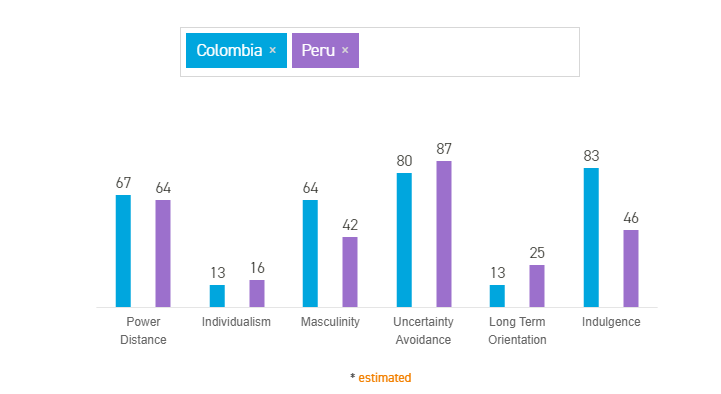
In this case, here you have the score between Peru and Colombia.
Final observations:
Power Distance: with a score of 67 Colombia seems to be a country in wich people accept the inequalities as a normal thing, and so does Peru. The difference is minimal.
Individualism: with a value of 16 Peru shows a very collectivistic score, in line with most other Latin American countries. On the other hand, Colombia is amongst the lowest Individualist scores which portrait it as one of the most collectivistic cultures in the world, beaten only by Ecuador, Panama and Guatemala.
Masculinity: at 42 Peru is a rather «Feminine» society that prefer human contacts and family over recognition or wealth, while Colombia is a «Masculine» society – highly success oriented.
Uncertainty avoidance: at 87 Peru scores high and so does the majority of Latin American countries that belonged to the Spanish kingdom. The Peruvian and Colombian culture show a strong need for rules and elaborate legal systems in order to structure life – Colombia to a lesser degree.
Long term orientation: with a low score of 25 and 13 respectively, Peruvian and Colombian culture tends to be more normative than pragmatic. Traditions are respected and conserved.
Indulgence: Peru has an intermediate score of 46 on this dimension, exceeded by Colombia with a significant difference. People in societies classified by a high score in Indulgence are generally linked to enjoying life and having fun.
Sources:
 Project 1