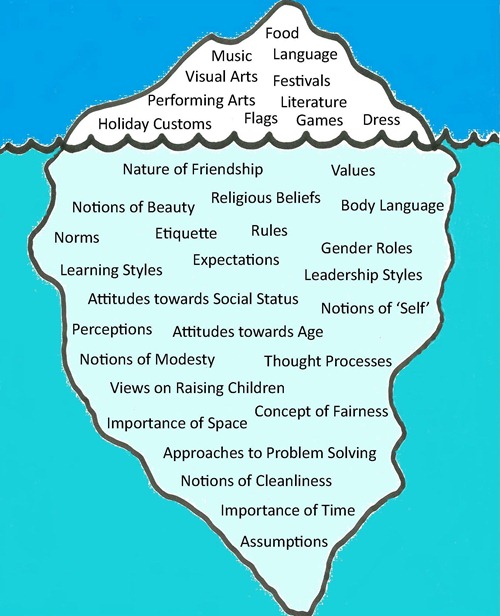
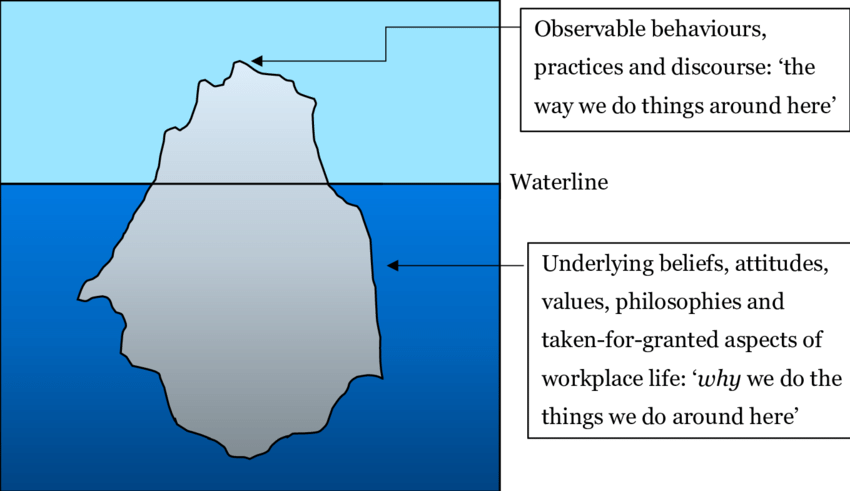
In an attempt to explain culture more clearly, many intercultural trainers use the Iceberg Model of Culture since they both have visible (on the surface) and invisible (below the surface) parts.
Elements of culture which we can plainly see, such as food or clothes, are represented by the upper portion of the iceberg.
Those elements which are not as obvious such as why someone eats or dresses the way they do are represented by the much larger portion of the iceberg underwater.
On the one hand, some of the visible aspects of the peruvian culture are:
-Food: Peruvian food is different in each region, so what they eat depends on where they live. Cuisine from the coast is based on seafood. Dishes from the Amazon use fish available in rivers and lots of tropical fruits. Andean cuisine is based on potatoes and meat. Thousands of years ago potatoes, maize, quinoa and the meat of llamas and guinea pigs were the only resources in the Andes. Today Peruvians combine those staple foods with others introduced by Europeans to create tasty and unique dishes. Some ancient cooking methods are still used today such as pachamanca, a hole dug in the ground and covered with hot stones where meat and potatoes are cooked.
-Music: One of the most important part of any Peruvian party, maybe after food, is music and dance. Andean music is world famous for the sweet sounds of its flutes and panpipes. String instruments introduced by the Spaniards such as charango, harps and violins complement the sounds of native drums, brass and wind instruments. Andean people have at least 300 different dances but the most popular is the huayno which is danced with vigorous stamping of the feet, dancers wear colorful costumes. Puno is the folklore capital of Peru.
Music from the coast is very different from Andean music. It is called Criollo music and has its origins in Spanish and African rhythms. The most popular criollo dance is Peruvian marinera, a traditional and graceful courtship dance performed using handkerchiefs. Its music is accompanied by cajon and guitar. One of the most popular composers and singers of criollo music was Chabuca Granda. Another new kind and popular music that emerged in the 1950s is chicha. Chicha has its origins in the shantytowns sourrounding Lima and it is named after a popular fermented corn drink. Chicha is a mix of Afro-Peruvian and Andean beats.
On the other hand, some of the invisible aspects of the peruvian culture are:
-Religion: The predominant religion is the Roman Catholic, but other Christian faiths are scattered. However, the indigenous people of Peru have blended their traditional beliefs and Catholic faith. The religious tolerance and freedom in Peru can be seen whereby certain evangelical groups are doing away in with traditional practices of these communities by the imposition of different lifestyle norms, such as the style of dressing. Religious tolerance and freedom are achieved through generosity to accept the virtues of the other, and this is the current state of the law in Peru whereby one is supposed to accept another person without trying to change them.
-Beauty perspective: Beauty in the strictly corporal sense covers both the esthetically beautiful and the attractive. Aesthetic beauty is associated with delicacy, softness, and fine features. Women possess beauty—softness/delicacy, while men are handsome— attractiveness/strength. Male beauty is called attractiveness and is directly associated with the strength expressed in a hard, muscular body, in firm thighs and buttocks. Attractive faces are associated with a display of security and authority both toward other males to command respect, and toward women to denote authority and firmness of character.
Sources:
https://www.machupicchu.org/peruvian_food.htm
https://www.peru-explorer.com/peruvian_music.htm
https://www.worldatlas.com/articles/religious-beliefs-in-peru.html
 Project 1