
A world traveler who speaks ten languages, British linguist Richard Lewis decided he was qualified to plot the world’s cultures on a chart.
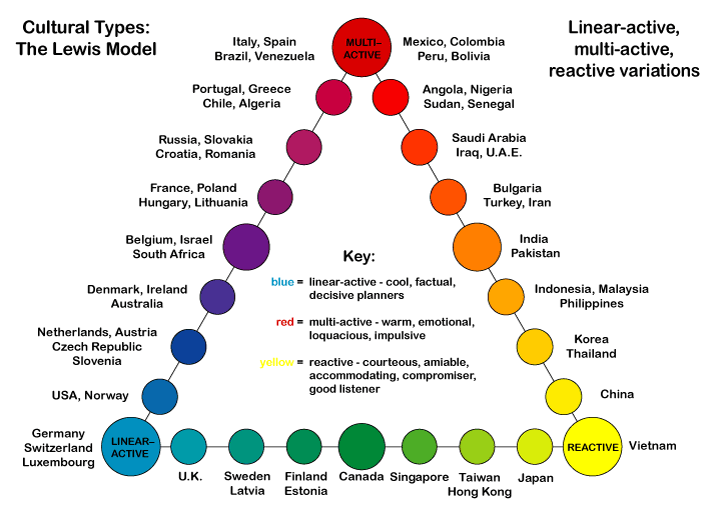
Lewis plots countries in relation to three categories:
- Linear-actives: those who plan, schedule, organize, pursue action chains, do one thing at a time. Germans and Swiss are in this group.
- Multi-actives: those lively, loquacious people who do many things at once, planning their priorities not according to a time schedule, but according to the relative thrill or importance that each appointment brings with it. Italians, Latin Americans and Arabs are members of this group.
- Reactives: those cultures that prioritize courtesy and respect, listening quietly and calmly to their interlocutors and reacting carefully to the other side’s proposals. Chinese, Japanese and Finns are in this group.
Indeed, the peruvian culture (within the Latin American tag) fits in the description of the multi-actives one.
Let’s dig deeper into this category.
The multi-actives are generally the people who:
- Talk most of the time.
- Do several things at once.
- Plan grand outline only.
- Confront emotionally.
- People oriented.
- Feelings before facts.
- Relationship oriented.
- Roam back and forth.
- Spoken words are important.
- Unrestrained body language.
Peruvians, as colombians, tend to be welcoming to foreigners. But the experience may be different to someone who has plans of living in the country an undefinite amount of time, because they are more exposed to the deeper sides of this culture (the invisible aspects of the iceberg).
On the other hand, the interaction between cultures within the same category may differ from the experience with cultures of other categories.
For example, let’s try the exercise of putting a peruvian random girl into the following situation:
She is a Music student at the National University of Peru and chose Colombia as the country she wanted to go in the exchange program.
First of all, the language barrier would not be a problem to her since the Spanish is the common language among Latin Americans.
However, if we want to be more geographically specific, let’s say she is from the capital city of Peru: Lima. She decided to come to Barranquilla in the month of August for the second term of the year. The aspects to take into account are:
- Weather: even though the weather in Barranquilla is generally hot, the average range of maximum versus minimum is 32°-25° respectively. In the month of August in Peru, the range goes from 15° to 19° as the maximum. The difference is significant to someone who is not used to the high temperatures of a city like Barranquilla.
- Physical characteristics: the average peruvian does not differ physically from the colombian that much. In fact, this girl could be mistaken as an indigenous person from rural zones in Colombia since the facial features are alike.
- Music: since the musical field is one of the most globalized in the actuality, it would not be a very different experience to her.
- Clothes: with climatic changes in Peru (4 stations), they are highly probable to have comfortable and light clothes to wear in hot weathers.
In conclution, the experience would not be as traumatic as other intercultural experiences could be.
Sources:
http://retailchile.blogspot.com/2013/09/the-lewis-model-explains-every-culture.html?m=0
 Project 1